





TV Cabinet in the Living Room
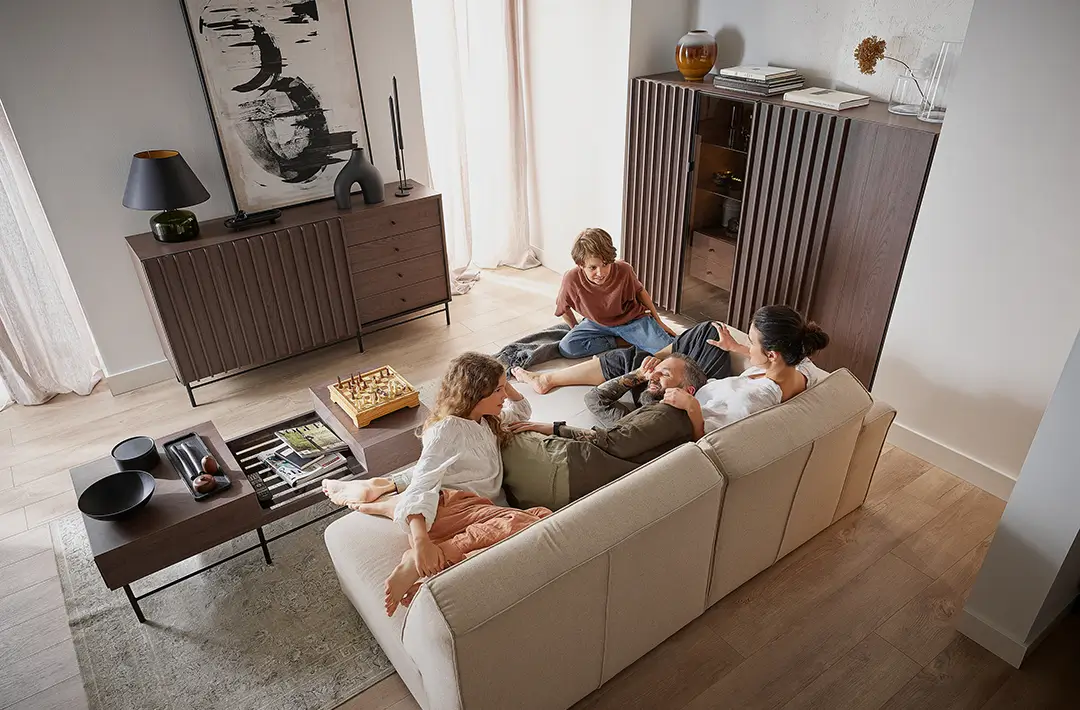
For many families, the TV area is the most important part of the living room. Its centerpiece is the TV cabinet, which holds the TV on its top and conceals multimedia equipment in its spacious compartments. How do you choose the perfect TV stand that will meet your family’s needs and serve as a decorative focal point for your entire living room? Read on!
Article at a Glance

A TV stand in the living room remains the most popular choice for TV furniture. But more and more often, living room designs feature a TV console as the centerpiece.
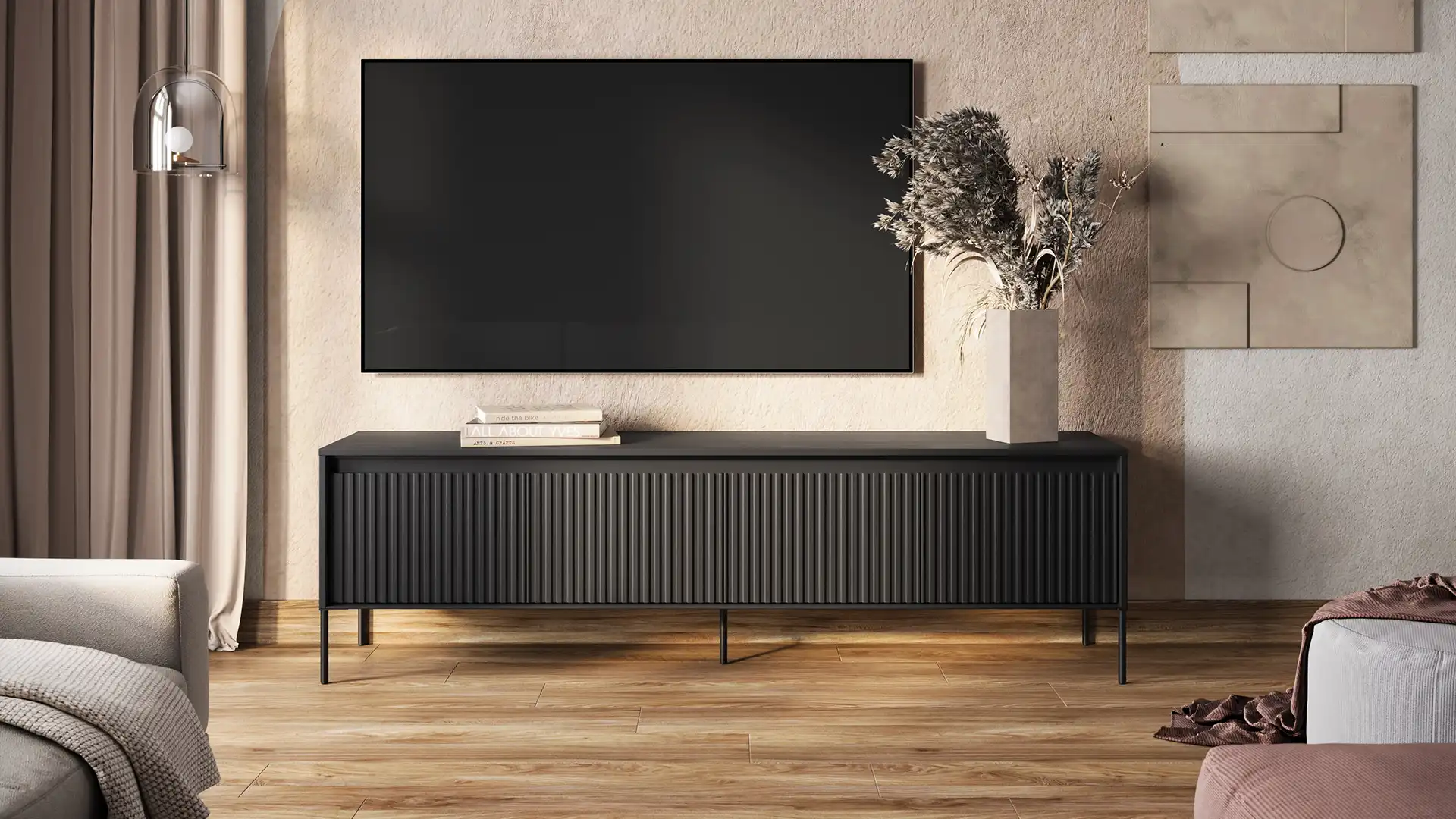
For a TV stand to look its best in the living room, it must be sized to fit the TV. TV stands look best when they’re at least 20 cm longer than the TV.
Generally, we opt for a TV stand in the living room that’s part of a complete set of elegant living room furniture. But you can also create an interesting arrangement using furniture in unique colors, such as a trendy blue TV stand.
Remember that a well-organized TV area in the living room or bedroom is one where cables aren’t tangled. You can hide unsightly cords in special cable covers or run them through plaster channels.
When choosing a TV stand, pay attention to its functionality. A TV cabinet with drawers and deep compartments will come in handy if you have a lot of multimedia equipment and additional accessories, such as remote controls, game controllers, or a collection of games.

How do you hide cables behind the TV cabinet?
Even the most beautiful living room design can be ruined by cables that stick out unsightly from behind the TV cabinet and trail across the floor to the nearest outlet or extension cord. And there can be a lot of cables—not just from the TV, but also from music equipment, a game console, or a set-top box. Fortunately, there are a few simple ways to hide these unsightly cables. What are they?
- It’s best to plan for several different outlets right next to the designated entertainment area, ideally behind the TV cabinet. It’s best to make this decision during the design or electrical work phase.
- The wires can be concealed in the wall, within a specially prepared cable channel.
- If the TV is mounted on the wall, it’s best to plan for outlets behind the TV.
- The simplest way to organize the cables running from the equipment on the TV stand to the distant outlets is to bundle them together with a cable tie. It’s not the most aesthetically pleasing solution, but even this level of organization will give the entire TV area a neater and more put-together look.
- The cables coming out of the TV cabinet in the living room can be hidden behind a special cover. What do they look like? They vary. Narrow fabric tubes with a sewn-in zipper work great. Self-adhesive strips in various colors—or ones you can paint any color you like—are also useful. Cable covers with a cable management box or special slats on a panel that hide cables are very elegant. The latter are available in the most popular furniture finishes, such as black, white, artisan oak, or craft oak, allowing them to create a cohesive look with the TV cabinet in the living room.
- It’s also important to choose the right TV cabinet for your living room—specifically, a model with a sufficiently large opening in the back for routing cables. You can also cut this type of opening in a TV cabinet yourself, preferably using a hole saw.

What can I use instead of a TV cabinet?
Not every living room has enough space for a TV stand. Sometimes the living room is too small to fit a TV stand that’s large enough. It’s worth keeping in mind that a large TV placed on a small TV stand in the living room doesn’t look very good. In a small living room, functionality should be the top priority. If you don’t have room for two pieces of furniture—a TV stand and a living room dresser—it’s better to choose the latter. Similarly, if you have a lot of things to store, you’ll likely choose spacious living room furniture, such as a chest of drawers or a tall cabinet, instead of a classic TV stand. But don’t worry—you can easily place your TV on such a chest of drawers or living room cabinet. A TV stand is also a great choice for the bedroom.
When looking for a chest of drawers that will also serve as a TV stand, choose one that has a special compartment for TV and audio equipment. Otherwise, you’ll have to place your set-top boxes or audio equipment directly on the top. Fortunately, today’s furniture market is well-suited to modern needs, so furniture stores are already offering specially designed TV chests.
Wall-mounted or freestanding TV cabinet?
Are you wondering which TV stand to choose for your living room—a wall-mounted one or a freestanding one? Freestanding TV stands are available in a variety of styles, ranging from modern (such as loft or Scandinavian) to more traditional designs. Wall-mounted TV stands, on the other hand, are characteristic of modern styles, such as glamour. So if your living room is decorated in a classic style, opt for a floor-standing TV stand. It’s also important to note that wall-mounted TV stands don’t have legs—a feature that’s been so trendy for several seasons now. So if you love stylish furniture with legs, choose a freestanding TV stand.
So much for style. Now let’s talk about functionality. A huge advantage of wall-mounted TV cabinets is that you can hang them at any height—higher or lower, depending on your other living room furniture and your family’s preferences. You can also easily change the location of the TV cabinet in your living room, for example, if you buy a taller sofa or a larger TV. Any vacuum cleaner, including self-cleaning models, can easily fit under a wall-mounted TV cabinet in the living room. Wall-mounted living room furniture also makes the interior appear larger and more spacious, so it works great in smaller living rooms.
No matter which model of living room cabinet you choose, be sure to consider its functionality and think ahead about what you want to store in it. If you have a lot of electronics, opt for a TV cabinet with compartments where you can easily store a set-top box or game console. If your family enjoys playing games together, choose a TV cabinet with drawers that can hold controllers, your game collection, and other digital accessories.
How to Choose a TV Cabinet for Your Living Room?
The primary criterion for choosing a TV stand for your living room is the size of the room. A long TV stand looks best in a spacious living room—one where you can not only place your TV but also display decorations. Remember that the TV stand should be at least 20 cm longer than the TV—only then will the whole setup look its best. In small living rooms, it’s better to opt for a smaller TV stand or a TV cabinet, which, in addition to holding the TV, will also provide plenty of storage space.
Similar posts
Home Entertainment Area—How to Plan It Right?
How can you design your home entertainment area so that it’s elegant, functional, and lets you enjoy time spent with your family?
Read more


How do I choose a loft-style TV cabinet?
A loft-style TV stand is a must-have for a loft-style living room. Which TV stand should you choose? A wall-mounted one or one on legs? With compartments or drawers?
Read more

What kind of TV stand should I get for my bedroom?
The perfect TV stand for the bedroom? How does a bedroom TV stand differ from a living room TV stand? We’ll explain!
Read more
TV Cabinet – What to Look for When Choosing One?
How can you best showcase your home library—in a display cabinet or on a classic bookshelf? Find out what works best for your home!
Read more
